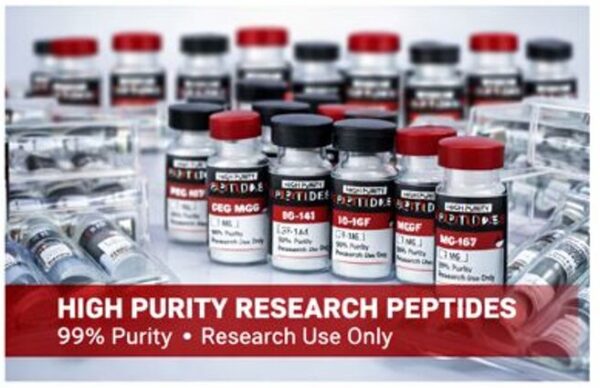
How To Keep Peptides: Managing & Storage Space Standards Once a peptide has actually been reconstituted, refrigerated storage is commonly dealt with as the conventional finest method due to the fact that water intro reduces stability. It is essential to reduce light exposure also throughout handling and reconstitution treatments. Stay clear of intense fluorescent lab check here lights that can cause peptide failure prior to your tests have even started, and instead operate in locations with inadequate lights. Store lyophilised peptides at minus 20 ° C for long-term storage or 2 to 8 ° C for short-term storage space. Additionally, in previous reports utilizing AAA of crude peptidepreparations to assess content without a desalting step were endangered byresidual scavenger reagents (42 ). Table 4 contrasts the AAA of the high andlower purity peptides received Fig. The presence ofpeptide species without the N-terminal residue follows the lowercontent of Phe in the reduced pureness prep work. Some amino acids were notdetected well in either the high or lower pureness examples. According to Verified Peptides, using airtight, inert-gas-flushed glass or dark containers with desiccants substantially reduces dampness and oxidative risks. The service life of peptide powder depends upon the storage problems. As a whole, lyophilized peptide powder can be kept at -20 ° C for regarding 1 year and at -80 ° C for regarding 3 years.
What cancels out peptides?
Salicylic acid''s scrubing activity may undercut the peptides, reducing their skin-repairing benefits. Referral: To prevent any kind of communication, use salicylic acid and peptide items at different times. For instance, integrate salicylic acid in your morning regimen and peptides in your evening routine.
. Basically, this turns around the freeze-drying procedure by adding a specific solvent to the dry peptide. Proper reconstitution makes certain the peptide completely liquifies without loss of task, so it can do as expected in experiments. It is a crucial action that needs to be done carefully to protect the peptide's integrity and make sure consistent outcomes. Reconstituted peptide options are normally steady for weeks to months when kept at -20 ° C or -80 ° C in an appropriate, sterile barrier, staying clear of repeated freeze-thaw cycles. The service life of recombinant peptides depends on a selection of aspects, consisting of the sort of peptide, storage conditions, and whether stabilizers or preservatives are included. Generally, recombinant peptides can continue to be active for weeks to months under suitable storage space problems (e.g., cooled at 2-8 ° C) At that point, the vial ought to be disposed of instead of compeling a jeopardized solution into research study use. Sometimes peptides withstand dissolving in spite of proper technique. Several variables can create this, and each has solutions. Angle the needle so water trickles down the internal glass wall surface of the vial. This mild approach prevents physical disturbance of the peptide structure. Adding room-temperature water to a cold vial develops thermal shock.
Amino acid calibrants and peptide/protein QC materials must be selectedcarefully to make certain accuracy of the dimensions.
A disparity from the expectedpeptide focus of the in-house criterion throughout routine AAA evaluation couldindicate either an issue with peptide hydrolysis or with accuracy of amino acidsmeasurement, or both.
After reconstitution and before sealing the vial for storage, gently flow inert gas into the headspace for numerous secs.
Keep vials upright, capped, and plainly identified, and avoid straight light.
Shop peptide vials generally area of your refrigerator, away from light, dampness, and extreme temperatures. Prevent keeping them in the fridge door, where temperature fluctuations, and frequent shaking of the vial happens each time it's opened. Stay clear of saving them in the refrigerator door, where temperature variations and regular trembling of the vial occur each time it's opened. Yes, if it is chemically sterile-- pure water is not a substitute.
Why A Storage Space Procedure Issues For Glp-1 Reconstitution
Companion with vendors that comprehend these concepts and can give assistance for your particular applications. Quality peptides integrated with appropriate dealing with develop the structure for development research explorations. Before opening or weighing peptides, position the vials in a desiccator and allow the vials to heat to area temperature. Moreover, it's Get more info been observed in some research studies that some peptides will also continue for more time at space temperature level. A previous study, for example, reported that some peptide vaccinations last up to 3 months at area temperature. Use proper strategy to minimize stopper damages with each gain access to.
Services & Products
In general, lyophilized peptides are much more stable than reconstituted products, while reconstituted peptides generally need cooled, more controlled handling problems. This is because numerous "peakgroups" (i.e., "clusters" of co-eluting or closely elutingchromatographic heights in the retention time home window of each gauged shift) arelikely to be present. Prior to reconstituting peptides, lyophilized powder needs to be broughtto space temperature in a desiccator to stay clear of water absorption in the unusedpeptide, therefore decreasing variants in concentration of lyophilized aliquots. Ifreconstituting a peptide for the very first time, and whenever feasible, a smallamount of the peptide should be reconstituted before devoting the entire lotby weighing out a little aliquot. The newly made Aβ (25-35) and (1-40) are soluble in oxygen-free water. Some old peptides may need the enhancement of acetic acid for dissolution. It is better to attempt water or 50% acetic acid and afterwards water down with the working barrier. This overview supplies functional approaches for dealing with, keeping, and collaborating with peptides in laboratory settings. Lyophilization preferably "secure" the peptide's structure by creating a glassy solid, yet any type of residual moisture or excipients can influence security. The glass change temperature level (T_g) of the dried out cake has to remain well above storage space temperature level; or else, the solid matrix can collapse. Lyophilized peptides are generally much more secure than reconstituted materials due to the fact that water has been eliminated, which helps reduce some usual degradation paths. Peptide storage matters since temperature level, dampness, light, and handling can all influence product security and integrity over time. Remember that while general standards relate to many peptides, certain sequences might have special requirements.