Peptide Purity Evaluation Service
Recognizing Peptide Purity: What 99%+ Really Suggests
HPLC tells you what percentage of your example is the main compound-- yet it does not confirm what that primary substance really is. An optimal with the best retention time can theoretically be an associated peptide with similar hydrophobicity. Mass spectrometry offers identity verification by gauging molecular mass directly. We review peptide length, sequence composition, anticipated molecular weight, adjustment type, salt kind, example history, and designated downstream use before specifying the logical path.Selecting the right exterior laboratory for peptide screening involves evaluating a number of elements. A trusted laboratory needs to have verifiable experience in peptide chemistry analysis-- for example, PhD-level drug stores or biochemists on staff who understand peptides' synthesis and destruction direct-sarmS pathways. Accreditation by relevant bodies (such as ISO/IEC or qualification for GLP/GMP conformity) is a solid indicator of quality.
Peptide Functional Evaluation In Biomedical Research Study
Other strategies like electrophoresis, capillary electrophoresis (CE), and nuclear magnetic vibration (NMR) can additionally be used to assess peptide framework, cost, and purity, guaranteeing thorough characterization. In COA evaluation, it normally includes HPLC pureness testing, mass spectrometry identity confirmation, and batch-specific paperwork revealing the tested lot, approach, results, and date. For peptide purity testing, reverse-phase HPLC is the standard theoretical version. The chromatographic pureness is after that determined by contrasting the location under the major top with the total area under all incorporated optimals.
If you've ever searched a peptide catalog, you have actually seen purity numbers all over. These numbers obtain thrown around so typically that it's very easy to gloss over them-- simply one more spec on an item page. Chameleon Peptides markets research substances solely for laboratory and logical objectives. All PRG items are planned solely for artificial insemination study or additional production use. Using a highly detoxified peptide minimizes these dangers and boosts the integrity of your data.What Can We Provide?
Nonetheless, accomplishing ultra-high pureness (say 99%) can be practically tough and might not always be essential, as we'll review later on. The key is recognizing what degree of purity is sufficient for your demands and how pureness is determined in the first place. For a lot of study purposes, high purity implies you can be confident that the large majority of the molecules in your vial are the right peptide, which aids make sure speculative uniformity and reproducibility. Our operations is created to relocate from sample context review to interpretable peptide information with marginal logical uncertainty. Tasks can vary from one example identification check to multi-lot comparability, residual evaluation, solubility evaluation, or stability-focused logical packages. Hydrophobic peptides, extremely basic series, changed constructs, and closely relevant analogs can be assessed with approach modifications matched to their analytical risks.This degree of detailed evaluation ensures the peptide's precision-- meaning the sequence and purity are specifically as labeled-- which is essential for speculative reproducibility. By verifying make-up via multiple validated approaches, laboratory recognition warranties that researchers receive a high-purity peptide that will certainly execute as anticipated in the laboratory. Laboratory validation of peptides is not only a clinical best method-- it's commonly a regulative demand when peptides are utilized in restorative growth or medical study.
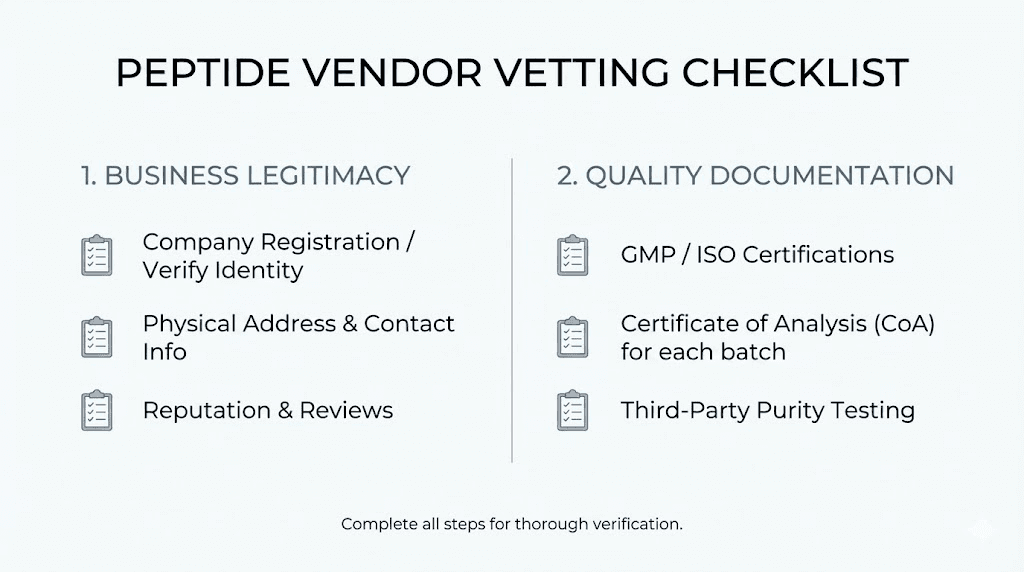
- Every item we bring is lab-tested and verified by third-party companions, so researchers understand specifically what they're collaborating with.
- For a much deeper identity-focused description, see Mass Spectrometry Peptide Verification.
- Peptides in microspheres and nanoparticles may with matrices, making it hard to separate totally free and encapsulated forms.
- In the end, getting the pureness level right means extra trustworthy scientific research-- which's the utmost objective for any type of scientist.
Trusted peptide screening labs will certainly offer a collection of modern logical methods-- HPLC combined with MS is a must, and availability of extra approaches like capillary electrophoresis or amino acid evaluation is an incentive. Be careful of laboratories that do not use mass spectrometry along with HPLC, as this might miss out on essential identity info. In a similar way, stay clear of labs that can not demonstrate verified logical approaches. In line with ICH standards, confirmed approaches indicate the lab has developed the examination's accuracy, precision, detection limitations, and so on, making certain the data you get are reliable.
Matching HPLC, labs use Mass Spectrometry (often paired as LC-MS) to validate the peptide's molecular weight and sequence identification. Mass spectrometry gives molecular confirmation by finding the exact mass of the peptide and any kind of co-eluting species or truncated sequences with high precision. With each other, HPLC and MS information enable experts to verify that the peptide's make-up matches what it should be (appropriate amino acid series and anticipated adjustments) and that no substantial pollutants exist. They are labeled "for research study usage just" to explain that they are intended for in vitro experiments or pet researches, except any type of type of human use. As a matter of fact, a laboratory offering peptide screening have to provide information meeting the rigorous logical assumptions of agencies like FDA and EMA [4] By utilizing a certified third-party lab, peptide suppliers or researchers guarantee an objective and skillfully recorded assessment of quality, which is specifically what inspectors try to find. Additionally, recurring independent testing sustains compliance in set release and quality assurance. Lab recognition for peptides implies making use of scientific tests to confirm a peptide's identity, purity, and structure. In practice, this commonly involves third-party or independent screening by an outside lab to verify that a peptide item actually has what the tag asserts [2] 